
Archway Academy Behaviour Guidance
1. Reward system
A commitment to emphasising the positive and always looking for opportunities to praise is central to our policy and practice. Verbal praise is routinely used, and telephone calls are used to inform parents and carers of good work and behaviour.
The ARCHES reward system is designed to enable students to become more involved with their learning, personal development, and behaviour. ‘Archies’ are awarded when students demonstrate achievement in the following areas:
Aspiration
Resilience
Citizenship
Health
Employability
Success
‘Archies’ are celebrated in:
- Weekly assemblies
- Phone calls home
- Newsletters
- Wall displays
Awarded Archies can be exchanged for a range of rewards ranging from individual prizes, form group awards and end of term educational visits.
2. Sanctions
In addition to our expectations and rewards, we have a system of sanctions for the following behaviours:
- Disruption of learning
- Refusal to follow instructions/work
- Verbal or physical abuse towards staff or other students
- Inappropriate physical contact towards staff or other students
- Health & Safety concerns which do not warrant an immediate exclusion
These sanctions are important to secure the safe and calm learning environment of the academy. Sanctions will be applied in a fair and consistent manner in line with these guidelines and the Behaviour Protocol (See final page).
3. Positive Handling / Physical intervention
The term ‘Positive Handling’ is used to describe the full range of strategies used to de-escalate, defuse and divert in order to prevent damage, violence and reduce the risk of injury to staff and students. The use of force only forms a small part of the Positive Handling Framework and will always be used as a last resort. All physical interventions, including restraint, are conducted within a framework of positive behaviour management. Preventative approaches to manage and reduce risks involve identifying and communicating early warning signs, highlighting triggers and other known factors which may negatively impact behaviour. All students therefore have a risk assessment document that tutors and behaviour mentors keep up to date.
A decision to intervene is solely down to the professional judgement of the individual staff member and will always depend on the unique circumstances.
The following list is not exhaustive but provides some examples of situations where reasonable force can be used. Schools can use reasonable force to:
- Remove disruptive children from the classroom where they have refused to follow an instruction to do so;
- Prevent a pupil behaving in a way that disrupts a school event or a school trip or visit;
- Prevent a pupil leaving the classroom where allowing the pupil to leave would risk their safety or lead to disrupting the behaviour/safety of others;
- Prevent a pupil from attacking a member of staff or another pupil, or to stop a fight; and
- Restrain a pupil at risk of harming themselves through physical outbursts.
During the use of any reasonable force staff must attempt to communicate, by:
- Issuing clear verbal instructions;
- Warning the child wherever possible of the consequences of failing to comply with instructions;
- Consistent, calm talking and listening throughout (to the child) to try to de-escalate the situation;
- Use only the minimum force necessary and for the minimum period necessary;
- Seek to avoid any injury to the child;
- Cease the use of restraint as soon as safety is re-established.
The academy will provide training for staff to ensure they know and understand the legal boundaries on the appropriate use of force. The academy does not require parental consent to use reasonable force. The academy maintains a log of ‘uses of reasonable force’. The information above refers only to the use of force to restrain or control, there are other occasions when physical contact other than reasonable force may be proper and necessary. These may include:
- Demonstrating how to play a musical instrument
- Demonstrating coaching techniques in PE
- Comforting a distressed child
- Providing first aid
- Congratulating or praising a child
Any aspects of this type of physical contact must be conducted with the child’s consent and will always recognise the inherent power imbalance between staff and child. Annual training will be provided to all staff covering this point.
No behaviour policy can cover all eventualities. The principal reserves the right to use their discretion, in line with this policy, to help all students at Archway to be ready, respectful and safe to thrive and grow as young people.
4. Archway Incident Report (A.I.R)
Any use of physical control must be reported on CPOMS on the day of the intervention. All details should be logged including; the incident, the behavior itself, and the use of physical intervention. Following an incident needing physical control, the student will be checked for injuries and parents/carers will be informed on the day, by phone call and receive notification in the post. Please see the full policy for further details. The Vice Principal (Behaviour) will oversee the recording on all AIRs. Staff will complete an AIR record, and the Vice Principal will monitor and record it in a bound book and allocate an individual reference number. Physical interventions will be monitored on a termly basis and reported to the Senior Leadership Team and the Academy Council.
5. Bullying
Bullying is not tolerated. Staff will be vigilant and confront all levels of bullying. Confirmed incidents of bullying will be recorded on CPOMS with the correct behaviour category description selected.
- Searching, Screening and Confiscation
Please refer to DfE guidance: Searching, screening and confiscation: Advice for head-teachers, school staff and governing bodies, (July 2022).
Searching, Screening and Confiscation
In addition to the list of prohibited items listed in this guidance, the Trust considers the following items to be prohibited in school:
- Electronic cigarettes and Vapes
- Contraband in the form of crisps, sweets, chewing gum and fizzy or energy drinks
- Catapults and steel ball bearings
- Stink bombs
- Devil Bangers (Fun snaps, Devil Snaps). Small twist of paper that bangs when thrown onto a hard surface.
Confiscated Items
The academy has the right to confiscate, retain or dispose of a students’ property as a punishment. Academy staff can seize any prohibited item found because of a search and can also seize any item considered harmful or detrimental to school discipline. The academy and its staff are not liable for any loss of, or damage to, any item they have confiscated in accordance with our policies and procedures. The academy will dispose of items in the following ways:
- Weapons, child pornography, or items which are evidence of an offence will be handed to a police officer
- Alcohol, tobacco, cigarettes and papers, e-cigarettes, fireworks will be disposed of by the academy. They will not be returned to the student
- Contraband in the form of crisps, sweets, chewing gum and fizzy or energy drinks will be disposed of
- Controlled substances will usually be passed to the police but may be disposed of by academy staff if there is good reason to do so. The principal will consider the relevant circumstances to determine whether they can safely dispose of the seized article. Where academy staff suspect that a substance is controlled it will be treated as a controlled substance
- Items which have been or could be used to commit an offence, or to cause personal injury or to damage property can be handed to the police or disposed of
- Items banned under the school rules will either be returned to parents/carers or disposed of. Jewellery can be collected by students at the end of the day
- Stolen items may be handed to the police or returned to the owner. They may also be retained or disposed of if returning them to their owner is not practicable. The police will not be involved for low value items
The academy will inform parents/carers where alcohol, illegal drugs or potentially harmful substances are found.
Mobile Phones
Mobile phones have no place in school. No student is permitted to use their mobile phones on the school site. Phones should be turned off before entering the building and handed in to a designated staff member on arrival who will store then in a safe and secure space. Reasonable adjustments are made for students who require the use of mobile phone technology to manage medical conditions e.g. Type 1 diabetes, Bluetooth hearing aids etc, this will be allowed and the student will carry a permission card. These arrangements are agreed with careers and individuals as appropriate.
Should a student be seen with a mobile phone then they will be asked to turn off the phone and hand it over. The phone will be secured in the academy’s designated space until a parent/carer can collect it (or as otherwise directed by the principal). Any refusal to comply with this reasonable request will result in referral to the principal for an appropriate and serious sanction to be issued. These arrangements are agreed with individuals as appropriate.
7. Trauma-Informed Practice
We understand that many pupils have experienced difficult life events, trauma, disrupted education, or social and emotional challenges. We recognise that behaviour is often a way of communicating feelings or unmet needs. Staff aim to understand the reasons behind behaviour and provide support to help pupils manage their emotions and make positive choices.
When incidents occur, staff work with pupils to identify triggers and develop strategies to improve behaviour, emotional regulation, and resilience.
Restorative Approaches
We use restorative approaches to help pupils understand the impact of their actions, take responsibility for their behaviour, and repair relationships when difficulties arise.
Following incidents, staff may hold restorative conversations to help pupils reflect on what happened, who was affected, and how things can be put right. The focus is on learning from mistakes and moving forward positively.
Positive Relationships
Positive relationships are at the heart of our approach to behaviour management. Staff treat pupils with respect, provide consistent support, and maintain clear expectations and boundaries.
By building trust and understanding each pupil's strengths, interests, and needs, staff help pupils feel safe, valued, and ready to engage in learning.
Individualised Support
We recognise that every pupil is different and may need different levels of support. Behaviour strategies are tailored to meet individual needs, including SEND, safeguarding concerns, and personal circumstances.
Where appropriate, pupils may have individual behaviour plans, risk assessments, or targeted support programmes. These are reviewed regularly with pupils, parents/carers, and other professionals.
Support and Accountability
We have high expectations for behaviour, attendance, and engagement. Pupils are expected to take responsibility for their actions and understand that poor behaviour may result in appropriate consequences. If deemed appropriate parents and careers may be contacted to seek a contribution towards any damage caused.
Consequences are applied fairly and consistently, with the aim of helping pupils learn from their actions and make better choices in the future. By combining support with accountability, we help pupils develop the skills needed for success in education, employment, and everyday life.
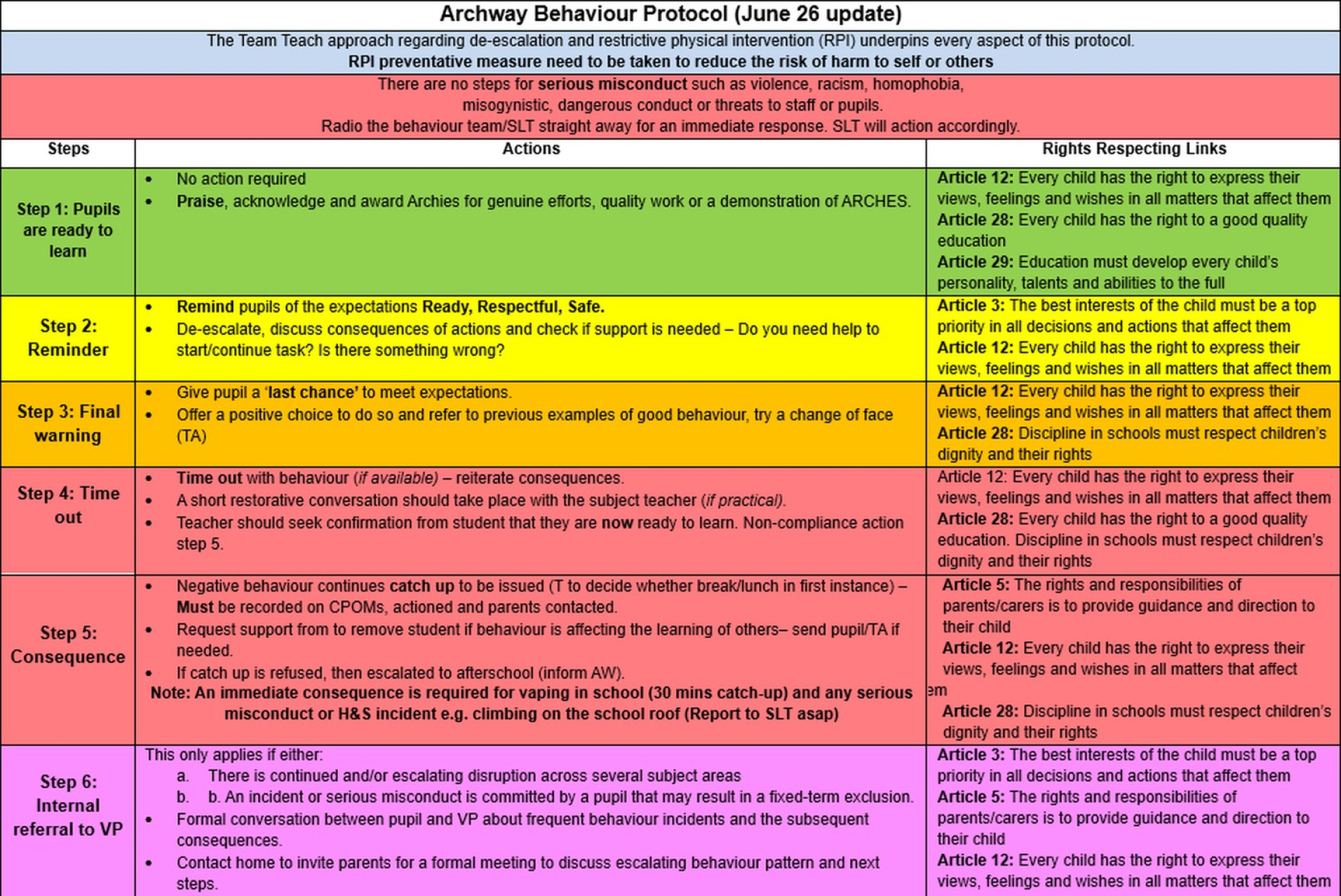
To view this file in its full PDF form click HERE